
Ever look at a company and wonder how active they really are? It can be hard to tell if they are a bustling hub of innovation or just have a forgotten website. The Activity Index is designed to answer that question for you.
Think of the Activity Index as a company's digital pulse. It measures their recent operational activity across different channels and combines it into a single, easy-to-understand score from 0 to 5. This helps you quickly see if a company is vibrant and engaged or quiet and inactive.
Where to find the Activity index:
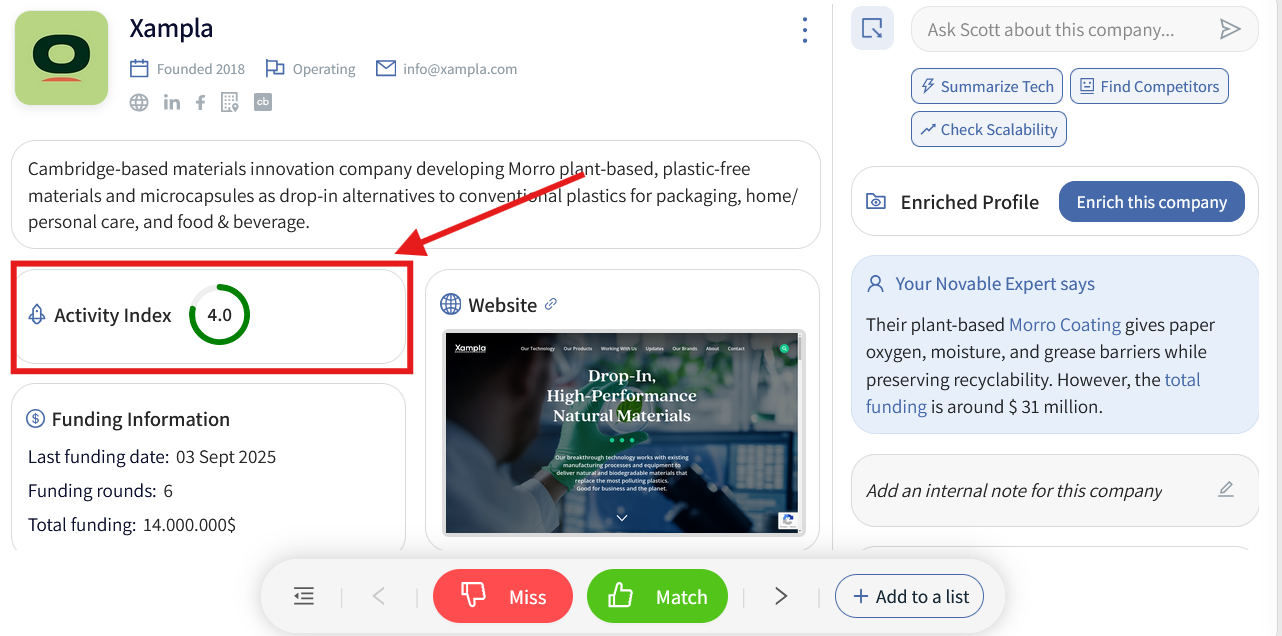
You can find the Activity Index on each company card. Look for the circular gauge, which displays the score from 0 to 5. It is located in the left section of the profile, right below the company's description.
Why the Activity Index is a Useful Tool
The main goal is to give you a more realistic picture of a company's online presence. A company that is consistently active across multiple areas, like updating its website and posting on LinkedIn, is likely more operational than one that just publishes a single blog post once a year. This score helps you spot the truly active players and saves you from chasing companies that have gone dormant.
How it Works: The Core Idea
The Activity Index is calculated based on two fundamental principles: recency and frequency, which together provide a holistic measure of a company's operational vitality.
The model prioritizes recent corporate activities, recognizing that their relevance diminishes over time. This is measured using a formula which reduces an activity’s score as more time passes since it occurred.
In addition to recency, the framework evaluates the consistency of operational activities. For dynamic metrics, such as LinkedIn engagement and content creation, frequency is often applied as a multiplier. This rewards companies that maintain a regular and sustained presence over those with sporadic bursts of activity, ensuring the system values a consistent market presence.
The Five Key Ingredients of the Score
We track five main types of activity to build the score. Some are more important than others, which is reflected in how much they contribute to the final number.
- Social network activity
- Website updates
- Content Creation
- Event Participation
- Other signals (these signals include address changes and recruitment activities for example, anything highlighting a movement in the team size).
A Note on Low Scores and Making Decisions
It's important to view the Activity Index as an additional input to help make your decision-making process easier, not as a final verdict on a company's worth.
A score of 0.5-1 means the company has extremely low, almost undetectable, digital activity. While this can be a red flag suggesting the company may be dormant, it doesn't automatically mean the startup is not worth looking at. It's simply a signal to proceed with caution and perhaps prioritize other, more active companies. The index is one piece of the puzzle to help you scout more efficiently.