
Ever come across a startup with genuinely mature technology and still wonder whether the company itself is ready to work with you? A high Technology Readiness Level (TRL) only tells you the product works. The ERL is designed to answer the other half: is the company behind it ready to be a reliable enterprise partner?
Think of the ERL as a company's operational and commercial pulse. It complements TRL rather than replacing it: where TRL evaluates the technology, ERL evaluates the entity behind it. It combines six weighted dimensions into a single score from 0 to 5, mapped onto five readiness levels.
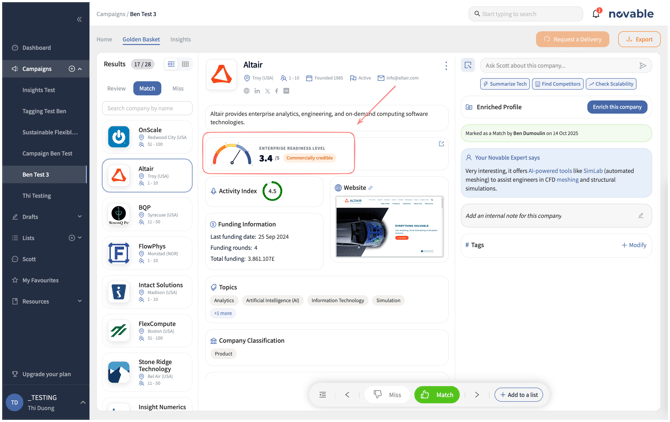
Where to find the ERL:
You can find the ERL on each company card, alongside the company's profile.
Why the ERL is a Useful Tool
A startup can have a mature technology and still lack security, compliance, scalability to go through a procurement process or manage the size of an enterprise. The technology is ready; the company is not. That gap is where most pilots die, and it's what the ERL flags before you commit resources.
How it Works: The Core Idea
The ERL is calculated from observable digital signals rather than self-reported questionnaires, which keeps it fast and consistent. An ERL Estimate is generated in seconds from a company's public footprint, with no cooperation needed from the company itself.
Two deeper levels build on top of this: an ERL Assessment adds structured evidence review from the company's own documentation, and an ERL Certification provides a formal, auditable designation for procurement.
The Six Key Dimensions of the Score
We track six dimensions to build the score. They're weighted by how strongly each predicts collaboration success:
- Identity (10%): legal existence, web presence, contact channels.
- Product (20%): documentation, API references, enterprise pricing.
- Technical (15%): architecture and integration readiness.
- Security & Compliance (20%): GDPR, SOC2/ISO27001, SSO/SAML support.
- Traction (15%): named customers, case studies, partner ecosystems.
- Operations (20%): customer success, support, SLA commitments.

The Five ERL Levels
- Concept: a value proposition, but no deployable product yet.
- Prototype: a working product; operations are still nascent.
- Early Commercial: first customers and revenue, but limited SLA or support infrastructure.
- Venture-Client Ready: structurally capable of a structured pilot.
- Enterprise Scalable: equipped for large-scale enterprise deployment.
A Note on Low Scores and Making Decisions
It's important to view the ERL as an additional input to help make your decision-making process easier, not as a final verdict on a company's worth.
An ERL 2 or ERL 3 company isn't automatically out of the running. It's simply a signal to calibrate the depth of engagement to its current stage, and to check the dimensional breakdown for exactly which gaps would need to close first. The ERL is one piece of the puzzle to help you scout and engage more efficiently.
What if a Score Doesn't Appear?
Sometimes, you might notice a company doesn't have an ERL Estimate displayed. This is intentional.
For the score to be reliable, we need enough public signals to work from. If a company's digital footprint is too sparse, we don't calculate a score rather than show you something that could be misleading. Moving to an ERL Assessment is usually the fastest way to get a reliable read in that case.